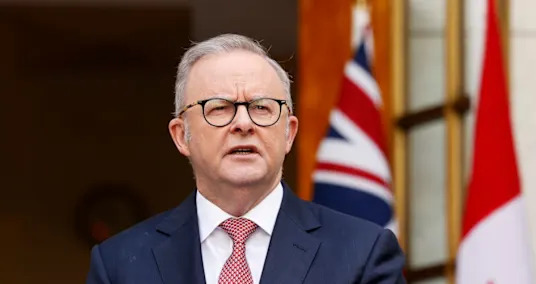
Prime minister Anthony Albanese has reassured Australians that fuel supplies will hold as panic buying sent demand surging by up to 400 per cent in some parts of the country, emptying service stations, and pushing prices to their highest levels in years.
He said on Friday that Australia's supply of petrol, diesel and oil would be "the same, if not higher, than it normally would be", with six tankers of jet fuel from China due to arrive between Saturday and 8 April.
Energy minister, Chris Bowen, said supplies from China were assured until late April or early May. Mr Albanese said shortages were a "distributional" issue concentrated in regional areas, and that there had been no reduction in fuel flowing into the country.
"We understand that people are under real pressure and the impact of this war is real," Mr Albanese told a press conference in the capital Canberra. "It's happening across the other side of the world. But in today's interconnected world, it's why we have to engage and we acknowledge that."
The reassurances came as the scale of the demand increased. Victorian energy minister Lily D'Ambrosio said demand had risen by between 300 and 400 per cent in some parts of the state, leaving more than 100 service stations without petrol and more than 80 without diesel on Tuesday.
In New South Wales, one in seven service stations had run out of at least one type of fuel by Friday, with 59 stations entirely without any fuel and 207 out of diesel. The Australian Competition and Consumer Commission said average diesel prices across the five largest cities had risen 10 per cent over the past week to 303.5 cents a litre, while regular unleaded petrol was up 8 per cent to 252.2 cents a litre.
The government said the shortages were driven by a rush of buying rather than any interruption to supply. "The fuels coming into the country, they're still flowing into the country," Ms D'Ambrosio told ABC Melbourne radio.
Mr Albanese said Monday's national cabinet meeting of state and territory leaders would work toward a coordinated national response, drawing on lessons from the Covid pandemic when different systems operating across states had complicated the response.
The opposition escalated pressure on the government, with opposition leader Angus Taylor calling for the federal fuel excise to be halved for three months – a move that could save motorists around 26 cents a litre on the current rate of 52.6 cents.
"Fuel prices are rising, stations are running dry, and families already stretched by the cost of living are falling further behind. This is now a national fuel crisis," he said.
National Party politician Matt Canavan said if the government's claims of adequate supply were true, "then this is a failure to get fuel where it is needed."
Treasurer Jim Chalmers said earlier this week that cutting the excise was "not something that we have been considering."
Mr Albanese declined to endorse the idea on Friday but did not rule it out, saying his government had "always been strong on cost of living measures" and would act "in a responsible way in the context of our budget considerations."
Economists have warned an excise cut could worsen shortages and add to inflation, with analysis showing the richest households would benefit most.
latest_posts
- 1
 Couch Styles of 2024: What's Moving
 - 2A volcanic eruption may have catalyzed the plague's arrival in Europe, study suggests
- 3How to watch the ‘Wicked: One Wonderful Night’ special — now streaming
- 4At least 36 dead in major fire in Hong Kong residential blocks
- 5IDF continues counterterrorism operations in Gaza Strip, including destroying terror tunnels



- What really happens when 140 reality stars come face to face with their biggest fans
- What did the gov’t approve for Israel’s 2026 state budget?
- Outer space conditions hamper sperm's ability to navigate toward an egg
- Releasing Learning Experiences: A Survey of the \Learning Made Fun\ Instructive Application
- What's an atmospheric river? AP explains the weather phenomenon
- A top Marine shares his secrets to keeping fit at 50
- The 1st full moon of 2026 rises tonight! Here's what to expect from January's supermoon Wolf Moon
- Intriguing Strange Cruising Objections you Should Visit
- German finance minister seeks better market access in China talks