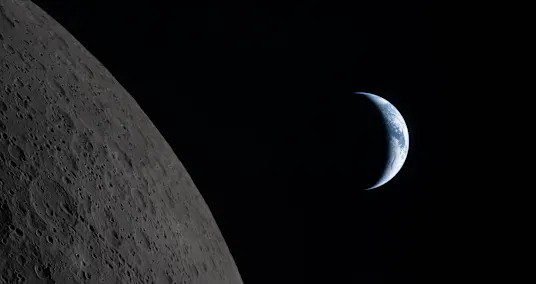
NASA has released the first images taken by the Artemis II crew during their historic trip around the far side of the moon.
The four astronauts — NASA commander Reid Wiseman, pilot Victor Glover, mission specialist Christina Koch and Canadian Space Agency mission specialist Jeremy Hansen — spent Monday’s seven-hour lunar flyby taking photos and making observations from the Orion spacecraft, which they named Integrity.
Among the stunning new images uploaded by NASA on Tuesday was a photo of “Earthset,” which was captured through the Orion capsule’s window at 6:41 p.m. ET, according to NASA.
"A muted blue Earth with bright white clouds sets behind the cratered lunar surface," the photo caption reads. "The dark portion of Earth is experiencing nighttime. On Earth’s day side, swirling clouds are visible over the Australia and Oceania region.”
Visible in the foreground is the moon, with the Ohm crater’s “terraced edges and a flat floor interrupted by central peaks,” per NASA’s description.

The crew also captured “Earthrise,” recreating the iconic photo taken during the Apollo 8 mission in 1968.

Also included in the new batch of images is a view of the solar eclipse that the crew experienced near the end of the flyby.

The astronauts donned eclipse viewers to protect their eyes during the nearly hour-long celestial event. But they still struggled to put into words what they were witnessing.

“Humans probably have not evolved to see what we're seeing," Glover told mission control. "It is truly hard to describe.”

Other photos captured close-up views of the lunar surface, including little-seen craters and basins from the vantage point of the crew, which at one point came within about 4,000 miles of the moon.
During Monday’s flyby, the Artemis II set a new record for the farthest distance from Earth traveled by humans — 252,756 miles, surpassing the previous mark set by Apollo 13 in 1970.


latest_posts
- 1
 How stripping diversity, equity and inclusion from health care may make Americans sicker
 - 2How to see the Ursids, the final meteor shower of 2025
- 3From a new flagship space telescope to lunar exploration, global cooperation – and competition – will make 2026 an exciting year for space
- 4Vinicultural Investigation: A Survey of \Enjoying Fine Vintages\ Wine sampling
- 5Will Comet C/2025 R3 (PanSTARRS) be the 'great comet' of 2026?


- Investigating Design and Individual Style: Track down Your Remarkable Look
- More than 800 flights canceled as FAA cuts traffic at 40 major airports. Here's what to know.
- Uzbekistan launches €9.46 billion green energy push, covering nation’s power needs
- A soft launch, an unfollow and a lot of questions: Breaking down the 'Summer House' romance blowing up group chats
- These 2 moon rovers used cameras and lasers to hunt for simulated water ice — and one looks like WALL-E
- Land Rover Just Unveiled Its Dakar Rally Defender
- The Following Huge Thing: 5 Progressive Tech New businesses
- Moon fever hits DC as Artemis 2 rocket 'candle' lights up Washington Monument just 1 month before launch (photos)
- A Pompeii site reveals the recipe for Roman concrete. It contradicts a famous architect’s writings